Practice worksheet
How to Read a Chinese Train Ticket: English and Chinese Fields
Read the complete departure and arrival stations, travel date, train number and departure time first. Then separate carriage and seat from the station’s gate and platform. A booking screen, itinerary sheet and current departure display have different jobs; a saved screenshot is a memory aid, while e-ticket travel requires the ticket information and the valid identity document used to purchase it. The diagram below is original teaching material, not a usable ticket.
First identify what you are looking at
You may be reading an app booking, a journey summary, an itinerary sheet or a station display. Do not assume that every rectangle containing a train number is a boarding document. The 12306 FAQ describes a railway e-ticket as an electronic passenger-transport contract and says passengers should retain its information and the valid identity document used to purchase it. It also states that an itinerary sheet and reimbursement receipt cannot be used as tickets. [1]
Start with the actual confirmed booking, rather than a search result, an unpaid request or a screenshot from an earlier train you considered. The public English order-page template separates train, passenger and seat information, price and status. Those headings help distinguish the fields; they are not evidence that a particular visitor has a booking. [3]
Layouts and wording vary across booking channels and documents. Our Chinese–English glossary is a reading aid, not a promise that every ticket prints every label in the same place. The examples contain no real passenger or booking data.
Use the original field map to keep six details separate
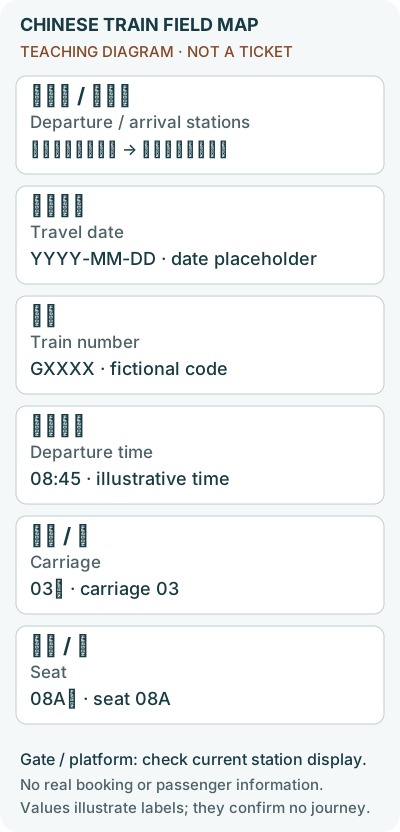
Download the teaching field map (SVG). Read the label before the value: 03 beside 车 refers to a carriage, while 08A beside a seat designation refers to a seat. Neither is automatically the boarding gate.
The diagram deliberately leaves the full station names and travel date as placeholders. Fill your own private journey record from the confirmed booking; do not copy the teaching values into a travel plan.
Chinese labels and the English question each answers
The official Chinese homepage visibly separates 出发地, 到达地, 出发日期, 乘车日期, 出发站, 到达站, 车次 and 检票口 in its public search and information controls. [2] The translations below explain those terms and additional common journey labels. They describe meaning rather than reproducing one account’s ticket layout.
| Chinese term | English reading aid | Question it answers |
|---|---|---|
| 出发站 / 发站 | Departure station | Which full railway station do I leave from? |
| 到达站 / 到站 | Arrival station | Which full railway station does this booked journey reach? |
| 乘车日期 / 出发日期 | Travel / departure date | On which stated date does the booked journey start? |
| 车次 | Train number | Which train identifier must match the current departure information? |
| 开车时间 / 出发时间 | Departure time | When is this booked departure? This is not the boarding-gate closing time. |
| 到达时间 | Arrival time | When does the itinerary show arrival, and is the arrival date different? |
| 车厢 / 车 | Carriage / car | Which carriage contains the assigned seat or berth? |
| 座位 / 座号 / 号 | Seat / seat designation | Which seat label should I find within that carriage? Read 号 with its context. |
| 席别 | Booked class or type | What class or accommodation does the booking specify? |
| 检票口 | Boarding / check-in gate | Where does the station currently direct this train’s passengers for the check? |
| 站台 | Platform | Which platform is currently assigned? It is separate from the seat and carriage. |
| 订单 / 状态 | Order / status | Is this an order record, and what does the booking channel say its status is? |
Do not infer a field solely from how its value looks. “03” might appear in more than one place; its label establishes whether it is part of a carriage, date or other identifier. Likewise, a number on an order record is not automatically the train number.
Read the booking in a useful order
- Separate departure from arrival. Find the complete station names. A city can have multiple stations; keep the suffix and Chinese name. Use the station-name reading guide for East, South, West and North examples.
- Read the departure date and time together. Check the actual date rather than assuming that a clock time refers to today. Keep arrival date and time on a separate line.
- Identify the train number. Preserve the entire identifier as displayed in the confirmed booking. Match it with the departure information; destination name alone can describe many trains.
- Read the booked class, carriage and seat or berth. Keep those labels distinct. A carriage number tells you where to look for the assigned place, not which train to board.
- Confirm passenger and booking requirements privately. Make sure the actual booking describes the traveller and the identity document required for the journey. Follow the railway or booking channel’s verification instructions.
- Recheck current station instructions. Follow the current gate, waiting-room, platform and boarding information for that train. Ask staff if the records or signs do not agree.
The official FAQ says passengers should take the train for the date and train number on the ticket, and should pay attention to station announcements, displays and staff reminders. [1] Reading the fields helps you make those matches; it does not verify a ticket or reserve a place.
Departure time is not the deadline for reaching the gate
Read clocks carefully. In a fictional date exercise, 2030-01-01 at 00:20 means early on 1 January, twenty minutes after midnight. It does not mean late evening that day. For an overnight journey, check the arrival date separately instead of copying the departure date into both fields.
A departure time also differs from the station’s boarding-check deadline. The 12306 FAQ says ticket sales and checks stop before departure, with the advance time given in station announcements. It notes that queues may occur at ticket windows, security, identity verification and gates. [1] This page gives no universal number of minutes that guarantees boarding at every station.
Use current guidance for the station and journey, allowing for reaching the correct entrance and moving through the checks. Do not use the example clock in the diagram as a schedule, or assume that being inside the building at departure time is sufficient.
Carriage, seat, gate and platform are different identifiers
In the diagram, 03车 means carriage 03 and 08A号 is the illustrative seat designation. First match the actual train, then its assigned carriage, then the place within that carriage. A similar-looking number elsewhere does not replace the field label.
A separately labelled 检票口 is a gate used in the station’s boarding process. 站台 is a platform. These are current operational instructions, not numbers you can calculate from 03 or 08A. Follow the station’s announcements and staff guidance when assignments change.
Do not use the seat letter alone to promise a particular view, facing direction, carriage layout or booked class. Read the actual class/type and assigned place, and ask the railway when an accommodation detail matters. A schematic field map contains none of that train-specific confirmation.
Keep the required identity document with the ticket information
The 12306 FAQ says foreign passengers can purchase real-name tickets using valid passports permitted under the relevant rules. For e-tickets, it tells passengers to retain the ticket information and the valid identity document used to purchase the ticket, and show that document for station entry/exit and boarding checks. [1]
Follow the actual verification instructions for your booking and seek staffed assistance if an automated check cannot handle the document. This field guide does not access a passenger account, assess passport validity or establish that every gate has the same scanning arrangements.
An itinerary sheet can make details easy to read, but the FAQ explicitly says it is not a ticket. The homemade diagram and check card are likewise teaching and navigation aids. If your record has a wrong passenger detail, unclear status or missing required document, contact the official channel or booking provider promptly rather than treating a neatly filled card as proof that the problem is resolved.
Save the useful fields without sharing personal details
Download the editable journey-field check card (TXT). It separates the booked fields from current station instructions. Fill it from the actual confirmed booking and recheck operational details on travel day.
For help with a field, you can use our original phrase 请帮我确认这趟车的检票口和车厢号。 — “Please help me confirm this train’s boarding gate and carriage number.” Show the relevant booking details privately to railway staff when needed; this page sends no message for you.
Leave document numbers, private order references and payment details off copies shared just for directions. Keep the full station name, date and departure information available for your own navigation. For the broader booking-to-boarding sequence, use the high-speed train guide.
Six cases for checking what a field means
These original teaching cases contain fictional notes, placeholders and calendar examples. They are not real tickets, booked services or tested boarding scenarios.
Case 1
A journey note lists 出发站 北京南 and 到达站 北京西. Which field names the station to reach before boarding?
Show answer and explanation for case 1
出发站 is the departure station: 北京南 in this fictional note.
到达站 is the arrival station. The example teaches field order and uses distinct verified Beijing names; it does not claim a train service between these stations. Keep the complete departure name rather than just “Beijing.”
Case 2
The teaching map shows 车次 GXXXX and 座位 08A号. Which field identifies the train to match on the departure display?
Show answer and explanation for case 2
车次, the train number. GXXXX is only a fictional placeholder; use your actual confirmed train number.
08A号 is the illustrative seat designation. A seat label is not a train number, and the diagram is not a booking confirmation.
Case 3
Your fictional note says 03车, 08A号 and 检票口 A08. Does the “08” in the gate make your carriage number 08?
Show answer and explanation for case 3
No. 03车 means carriage 03; 08A号 is the seat; A08 is the separately labelled example gate.
The identifiers belong to different levels. Follow the current assigned gate, then locate the actual carriage and seat. Do not derive a carriage from a similar-looking gate or seat number.
Case 4
A date-and-time reading exercise shows 2030-01-01 at 00:20. Does that mean late evening on 1 January?
Show answer and explanation for case 4
No. 00:20 is twenty minutes after midnight at the beginning of the stated date.
Read the date and clock together. This is a calendar exercise, not a scheduled train. Check the actual booking’s departure and arrival dates instead of treating an overnight arrival as necessarily the same day.
Case 5
You printed an itinerary sheet and also made this field card. Can either replace the ticket or required original identity document?
Show answer and explanation for case 5
No. The 12306 FAQ says an itinerary sheet is not a ticket; the homemade card is only a reading aid.
For e-ticket travel, retain the ticket information and the valid identity document used to purchase it, following the railway’s requirements. A convenient paper summary is not automatic permission to board.
Case 6
A saved screenshot names one gate, but the station display and staff give a different current gate for your confirmed train. Which source should guide the next step?
Show answer and explanation for case 6
Match the actual train number and departure details, then follow current station displays and staff instructions.
The official FAQ tells passengers to pay attention to current platform, waiting-room, gate and boarding-time information. If anything is unclear, ask staff; an old screenshot does not settle a changed assignment.
Sources and further reading
- China Railway 12306: English FAQE-ticket and identity requirements, ticket date/train-number validity, itinerary-sheet limits and current station boarding information; not a copied refund, child-ticket or luggage policy.
- China Railway 12306: Chinese homepagePublic Chinese labels for departure/arrival place and station, travel/departure date, train number and boarding-gate queries.
- China Railway 12306: Public English ticket-order pageThe publicly accessible template headings separating train, passenger, seat, price and status; no passenger login, live order or seat confirmation inspected.
Use actual journey details when reporting a carried item
If you left a possession on the train or at the station, report the known journey and last-seen place, keeping uncertain details marked unknown. This is a railway-item task, separate from airline checked baggage.