Practical guide
Hard Sleeper vs Soft Sleeper in China: Berths and Booking Details
Compare the common six-bunk open bay and four-berth compartment, then check the actual train, berth level, companions, bags, price and allocation. Two original cutaways and two records keep preferences separate from confirmations.
The usual difference: six open bunks or four berths behind a door
On common conventional Chinese overnight trains, hard sleeper (硬卧) means an open bay with six bunks: two lower, two middle and two upper. Soft sleeper (软卧) usually means a compartment with four berths: two lower and two upper, with a door. “Hard” does not mean an unpadded wooden bed; the conventional examples described in Seat61's rail guide have padded bunks and bedding.
That is the starting comparison, not the specification of every train. Read the accommodation class offered for your exact service, then confirm its carriage arrangement and assigned berth. Different rolling stock can use different layouts, including sleeper accommodation on D-numbered trains.
| Detail | Hard sleeper example | Soft sleeper example |
|---|---|---|
| Places in one bay or compartment | Six bunks in three levels | Four berths in two levels |
| Enclosure | Open bay beside a carriage corridor | Compartment with a door |
| Berth labels to distinguish | Upper, middle and lower | Upper and lower |
| What you buy | The assigned passenger berth | The assigned passenger berth, not automatically the whole compartment |
| Main preference question | Can I manage the allocated level and open arrangement? | Does the enclosure and allocated level suit me? |
| What the class does not establish | Your exact model, allocation or luggage space | A private cabin, lower berth or guaranteed quiet |
Choose by the features you need, not by a universal comfort ranking. A traveller who cannot use an upper berth has a different decision from someone whose main preference is a compartment door. The more expensive class is not automatically the answer to an access requirement.
Read the original cutaways without using them as berth-number maps
These original diagrams show the two common conventional patterns from the side facing a bay or compartment. Count the levels and places. They are simplified teaching cutaways, not a full carriage floor plan, scale drawing, current train photograph or booking allocation.
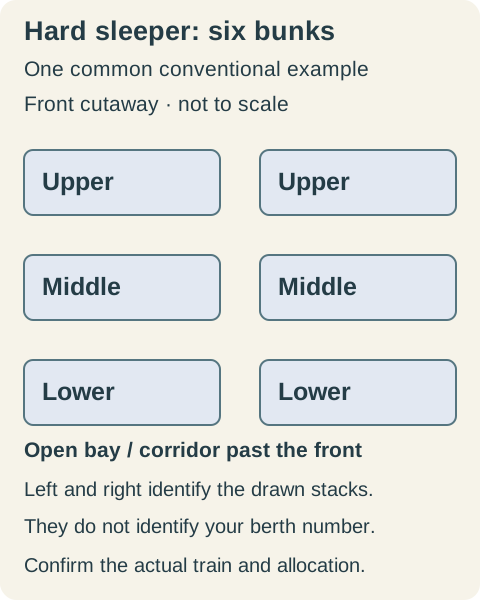
Download the six-bunk hard-sleeper cutaway (SVG).
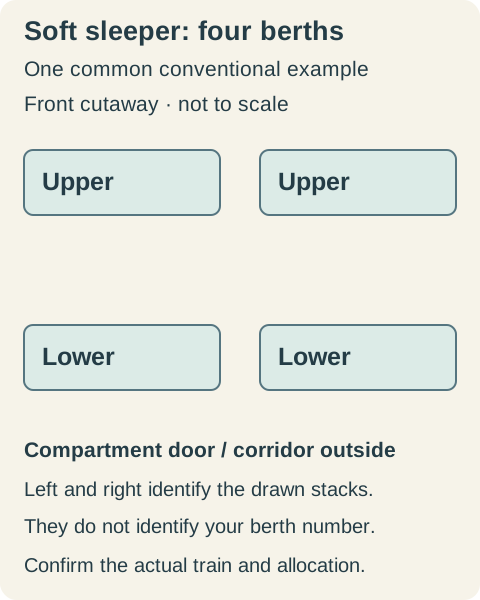
Download the four-berth soft-sleeper cutaway (SVG).
Left and right only separate the illustrated stacks. They do not establish a window side, travel direction, real berth number or how your booking channel numbers a particular carriage. Use the actual carriage and berth designation for finding your place.
Treat the berth level as a separate choice
Soft sleeper still includes upper berths. Selecting that class does not by itself secure a lower berth. Distinguish a necessary condition from a preference: “I need an allocation I can use” is different from “I would like the lower berth if available.”
Think through getting onto the berth, reaching belongings, moving to the toilet and getting down when tired. If climbing or movement is a concern, ask the railway about the actual berth and applicable assistance before committing. A lower berth label alone does not establish an accessible station route, carriage entrance or toilet.
| Priority | What to ask about this service | What to keep unconfirmed |
|---|---|---|
| Avoid climbing | What level is actually assigned, and can the required allocation be obtained? | That a preference request guarantees a lower berth |
| A middle hard-sleeper bunk | How is this particular berth reached and used? | That its space or ladder matches another train photo |
| Upper soft-sleeper berth | Can I manage this allocation and my essentials? | That paying for soft sleeper removes all climbing |
| Assistance or access requirement | What assistance, route and facilities apply at both stations and on the train? | That the class name is an accessibility assessment |
Follow crew instructions and respect each passenger's assigned place. Do not plan to solve an unsuitable allocation by occupying somebody else's berth or assuming a stranger will exchange places. If the required allocation is unavailable, keep another train, class or travel arrangement as a genuine alternative.
Check the exact carriage: the train letter is not a layout guarantee
The distinction between hard and soft sleepers is most useful when the actual service offers those categories. A daytime train with seats is a different comparison. Do not turn a first-class seat into a sleeper in your notes because its fare is higher.
Seat61 describes both four-berth soft-sleeper compartments and individual curtained sleeper arrangements on certain D-category services; it also describes a D-category type offering hard sleepers. That variation is the reason to check the particular train rather than treating “D” as one universal interior.
Deluxe or superior soft sleeper is also a separate accommodation label, not a synonym for ordinary soft sleeper. The guide describes two-berth examples on some services. Availability, facilities and allocation still need checking for the service you intend to book.
A China Daily report republished by Shanghai's government on 18 June 2024 likewise discussed ordinary and premium overnight accommodation on the newly introduced Hong Kong services. It is a historical example of variation, not confirmation of today's timetable, fares or interior. Do not apply its inaugural-service facilities to an unrelated domestic train.
If a model or cabin description matters, ask: “What accommodation layout applies to this train, date and class?” Keep the answer with the exact service. A promotional photograph of another train does not answer that question.
Compare the actual fare and allocation before payment
Compare prices for the same traveller, date, station pair and train where both classes are offered. Then examine the actual berth level and fees. A cheaper fare on another departure may involve a different station, arrival date or accommodation; it is not a clean class-price comparison.
In a fictional quote exercise, one option is 240 yuan plus a 20-yuan agency fee and another is 360 yuan with no separate fee. The totals are 260 and 360 yuan, a difference of 100 yuan. These are invented amounts for adding quoted charges, not railway prices or a typical hard-to-soft upgrade cost.
| Stage | Useful check | Outcome not established yet |
|---|---|---|
| Search result | Exact date, stations, train and offered class | A held berth for this passenger |
| Preference or agency request | Whether a level or shared compartment is requested or actually confirmed | The requested allocation |
| Order and payment | Passenger, class, price, fees and current order status | That an incomplete or failed payment created a usable booking |
| Confirmed allocation | Each passenger's actual carriage and berth details | That companions automatically share one compartment |
For several travellers, compare all allocations. Two soft-sleeper bookings do not reserve the other two places; even four travellers need to check their actual allocations rather than infer one shared compartment from a group request.
The public 12306 order template separates train, passenger and seat information, price and status. That structure is useful for checking the record. We have not opened a passenger account, inspected a live private order or tested a berth-selection feature. Follow the current channel's instructions for requests, allocation and changes.
Plan bags and overnight essentials for the berth you actually have
Paying for a higher class does not prove that a particular suitcase will fit or that a different allowance applies. Check the current railway rules for the journey and the actual storage arrangement. Measure and weigh bags when those details are needed; a photograph cannot establish usable space for your luggage.
| Item to plan | Useful preparation | Question for the actual journey |
|---|---|---|
| Main suitcase | Know its size and weight and who can move it | Where may it be stored without obstructing the route? |
| Required document and private booking details | Keep them accessible and secure | What identity document and boarding instructions apply? |
| Small overnight essentials | Keep permitted essentials reachable without repeatedly opening the large bag | Can I reach them from my allocated berth? |
| Arrival movement | Save the arrival station, date, onward address and practical transport plan | Does the arrival arrangement work at that hour? |
Keep aisles and access routes clear and follow crew directions for storage. If lifting or handling a bag is a problem, resolve it through an appropriate arrangement; do not base the trip on an unconfirmed promise that another passenger will carry it.
For overnight travel, read departure and arrival dates separately. Check the exact stations, current boarding instructions and how you will leave the arrival station. A bed on the train does not guarantee enough sleep or replace checking hotel opening times and onward transport.
For e-tickets, 12306's English FAQ requires the valid identity document used to purchase the ticket and says an itinerary sheet and reimbursement receipt are not tickets. Keep the required original document with you. A preference worksheet, screenshot or this diagram is a memory aid, not a boarding credential.
Save your priorities, then check them against the actual order
Use the first record before choosing and the second after allocation. Write “unknown” where a detail is unresolved. A neat form cannot make an unconfirmed level, shared compartment or assistance arrangement real.
Keep passenger names, document numbers and full booking references private. A companion's planning copy can usually use a passenger reference. Share the relevant full details only through the appropriate private booking or railway-help channel when needed.
SLEEPER CHOICE — PERSONAL PRIORITIES
Check date and passenger reference:
Exact train, travel date and station pair:
Class name shown by the booking channel:
Carriage model or layout confirmed from:
Berth level needed / preferred / flexible:
Climbing or assistance question to resolve:
Companions and required proximity:
Bag count, measurements and handling plan:
Fare, service fee and acceptable alternative:
Unresolved detail and official next question:
SLEEPER ORDER — CHECK THE ACTUAL ALLOCATION
Booking channel and current status:
Passenger record checked privately:
Departure station, date and time:
Arrival station, date and time:
Exact train and booked accommodation class:
Assigned carriage and berth designation:
Confirmed level, or level still unknown:
Companions' allocations checked separately:
Applicable change/refund information checked:
Required document and travel-day help plan:
Download both blank records and the six explained checks (TXT).
Recheck current change and refund instructions for the specific order if the allocation does not meet your needs. This guide gives no universal free-upgrade, exchange or refund promise. The reviewed English FAQ retains some older wording alongside later updates; use the applicable current process and ask about the actual booking.
For detailed passenger fields, use the passport-information checklist. For train, carriage and journey labels, use the ticket-field reading guide. Those checks remain separate from choosing accommodation.
Check six common assumptions before relying on a booking
These are original fictional scenarios for interpreting choices and confirmations. They are not real bookings, observed train rides or tested railway decisions.
Case 1
Two travellers buy soft-sleeper berths in the same four-berth compartment. Have they automatically bought a private compartment?
Show answer and explanation for case 1
No. Two assigned places do not reserve the other places.
Ordinary soft-sleeper accommodation can be shared. Check the actual allocation and applicable booking rules; do not promise privacy from the class name.
Case 2
A traveller needs to avoid climbing but has only requested a lower berth. Is selecting soft sleeper enough to settle the access question?
Show answer and explanation for case 2
No. Check the confirmed level and the actual access arrangement.
Soft sleeper has upper as well as lower berths in the common layout. A preference is not a confirmed allocation, and a lower berth does not establish accessible station and toilet facilities.
Case 3
The train identifier starts with D. Can you assume every sleeper place is in the same four-berth compartment layout?
Show answer and explanation for case 3
No. Verify the class and carriage on this service.
The reviewed layout guide describes variation among D-category sleeper trains, including individual curtained arrangements and a type with hard sleepers. A letter is not a complete interior specification.
Case 4
Four companions submitted one request for soft sleeper. Must all four confirmed berths be in one compartment?
Show answer and explanation for case 4
No. Read every actual carriage and berth allocation.
A shared request expresses a preference, while the confirmed order establishes the assigned places. If proximity matters, check it before depending on the arrangement.
Case 5
Soft sleeper costs more in your quote. Does that prove a larger suitcase will fit or qualify for a larger allowance?
Show answer and explanation for case 5
No. Check the current allowance and real storage arrangement separately.
Price is not a measurement of bag space or permission. Keep bag dimensions, handling and the railway's applicable rules separate from your accommodation preference.
Case 6
An agency says it has requested your preferred lower berth, but the order is still unconfirmed. Can you treat that message as a confirmed lower-berth booking?
Show answer and explanation for case 6
No. Check the actual booking status and allocation.
A request, pending payment or wait for allocation does not establish the outcome. Resolve the requirement through the booking channel and keep an alternative if it cannot be met.
Sources and further reading
- China Railway 12306: English FAQOfficial booking channels, accurate passenger information, e-ticket identity requirements, station guidance and change availability. Older and newer clauses coexist; no universal fee, child or luggage limits copied.
- China Railway 12306: public English order pagePublic template separates train, passenger, seat, price and status. No private order or berth-selection transaction inspected.
- Shanghai government: How to buy train ticketsOfficial-channel and purchase context; page visibly updated 11 June 2026. Not evidence of a specific sleeper allocation.
- Shanghai government / China Daily: HK high-speed sleeper service praised on debutHistorical report dated 18 June 2024 illustrates different accommodation categories. Not current timetable, rate or facilities verification.
- Seat61: Chinese train sleeper layoutsFive complete visible layout paragraphs only: conventional hard, soft and deluxe examples and D-category variation. Independent rail-travel observations, not operator policy; other page sections and photos not claimed reviewed.